Landing pages for concrete contractors
A concrete landing page is the page a paid click lands on, and it has one job: turn a stranger into a phone call or a quote request. Build one page per service, one page per city worth having one, and match what the page says to what the ad promised. A homepage listing nine services is the most expensive mistake in a contractor ad account.
What a landing page actually is
A landing page is just the page somebody lands on after clicking. That is the whole definition. It does not have to be stripped down, it does not have to live on a separate tool, and for a concrete contractor it usually should not.
What makes it a landing page is the job it is doing. A homepage introduces a business. A landing page answers one question for one kind of buyer and gives them one obvious thing to do next. Those are different jobs, and one page cannot do both well.
The reason this matters is money. You are paying per click. Every visitor who has to hunt around your site to find out whether you do garage slabs is a visitor you already paid for and are now losing.
The ten minutes it has to survive
Nobody hires a concrete contractor off one page. They click your ad, open two or three more in other tabs, and compare. That comparison usually happens on a phone, often in the evening, and it is mostly decided on photos and how fast the page loads.
So the page is not trying to close the sale. It is trying to survive the comparison and get the call. Those are different targets, and aiming at the wrong one is why a lot of well-written pages do not convert.
What gets you eliminated, roughly in the order it happens: the page is slow, there are no photos of work like theirs, there is no sign of what it might cost, there is no obvious way to call, or nothing on the page suggests you work near them.
What goes on the page, in order
Top to bottom, this is the order that works for contractor traffic. Each block is answering a question the visitor has not asked out loud yet.
| Block | The unasked question | What it needs |
|---|---|---|
| Headline | Am I in the right place? | The service and the place, in plain words. “Concrete driveways in Surrey” beats “Quality you can trust”. |
| Hero photo | Do they do work like mine? | A finished job of that exact type. Your own, not a stock photo. |
| Call button | How do I reach them? | Tappable, above the fold, visible again as you scroll. |
| Proof | Can I trust them? | Reviews on the page, not just a link to Google. Star rating and a count. |
| Price signal | Can I afford this? | A range, a starting point, or what drives the number. Silence reads as expensive. |
| Gallery | Is the finish any good? | Six to twelve real jobs, captioned with the city and the finish. |
| Process | What happens if I call? | Four or five steps, with a timeline. Removes the fear of being sold to. |
| Service area | Do they come here? | Written out in words. A map pin is not readable by a search engine or a skim reader. |
| FAQ | The three things holding me back | Price, timeline, and whatever your crews get asked most. |
| Form | Can I do this without phoning? | Short, and monitored. Roughly half of people will not call a stranger. |
The price signal is the one contractors fight hardest. The worry is that a number scares people off or ties your hands. In practice a homeowner who sees no price at all assumes the worst, and the quote they are comparing you against usually does have one. A range with the reasons it moves is enough.
Which service pages are worth building first depends on the work. Driveway companies should start with replacement and repair, because those are the searches with a decision already behind them.
Service pages, one per job you pour
A driveway buyer and a foundation buyer are not the same person. Different budget, different urgency, different worry. A garage slab is a project somebody chose. A cracked foundation is a problem somebody is frightened of. The same page cannot talk to both.
Build one page for each service you actually want more of. Not every service you are capable of, just the ones you want the phone to ring about.
| Page | Who is reading it | What has to be on it |
|---|---|---|
| Driveways | Planning a replacement, comparing three quotes | Finish options, removal of the old slab, base prep, a price range |
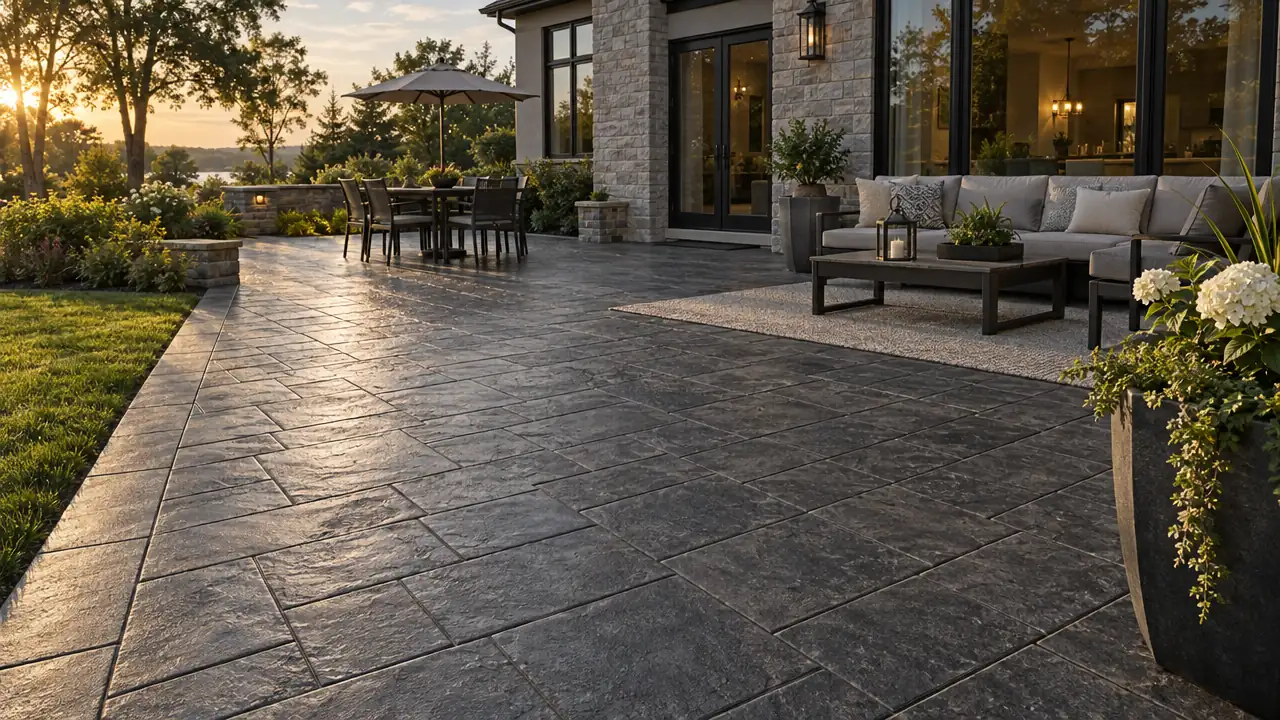
| Patios and hardscape | Buying a want, not a need. Slower decision | Photos above everything. Stamped and exposed aggregate galleries |
| Garage and shop slabs | Practical, price-sensitive, wants it done | Thickness, rebar, drainage, how long before they can park on it |
| Foundations and footings | Builder or a homeowner with a problem | Engineering, inspections, insurance, and that you have done it before |
| Repair and resurfacing | Wants to know if it can be saved | An honest repair-versus-replace answer. This one converts on trust |
| Commercial flatwork | A property or site manager at their desk | Insurance, WCB, night pours, references, a different tone entirely |
The repair page is the one most contractors skip and it is often the best performer. People searching to find out whether their slab can be saved are early, worried and not yet talking to anybody else. Answer the question honestly, including when the answer is replace it, and a good share of them stop shopping.
City pages, and the doorway trap
Location pages are the best-paying asset in contractor marketing and the easiest one to get badly wrong.
Here is the trap. Somebody tells you that a page per city will rank, so you make thirty pages that are identical except for the city name. Google calls that a doorway network. It filters those pages out, and it can drag the rest of your site down with them. You have paid to make your whole site worse.
The test we use is simple: can you write 600 genuinely different words about that market? Not padding. Real differences.
- What people actually build there. Acreage driveways are not city driveways.
- What the ground and the weather do to a pour. Clay, frost depth, freeze and thaw cycles.
- Which services carry that market, and which barely sell.
- Who you are up against locally, and where they are weak.
- Jobs you have finished there, photographed, with the street or neighbourhood named.
If you cannot fill that list, do not build the page. Cover the city inside a service area section instead and spend the effort on a market you can write about properly.
Service plus city pages
The next question is always whether to build “stamped concrete patios in Abbotsford” as its own page. Sometimes. The rule is the same as above with one extra condition: there has to be enough demand for that exact combination to be worth a page of its own.
A practical order for most contractors:
- Service pages for everything you want more of. These do the most work for the least risk.
- One city page for your main market, written properly.
- City pages for the next two or three markets, only if you pass the 600-word test.
- Service plus city pages, and only for your highest value service in your best market.
Most contractors never need to reach step four. The ones who do usually know it because the ad account is telling them.
Message match, and why it lowers your click cost
Message match means the page says back what the ad promised. Somebody searches “garage slab cost Edmonton”, the ad says garage slabs in Edmonton, and the page headline says garage slabs in Edmonton. Nothing in that chain makes them wonder if they clicked the wrong thing.
This is not only about conversion. Google scores how well your ad, keyword and landing page match the search, and a better score lowers what you pay per click. So a page that matches the ad costs you less per click and turns more of those clicks into calls. It works in both directions at the same time.
In practice that means one landing page per ad group, not one landing page per campaign. If your driveway campaign has an ad group for replacement and another for new pours, and the page can honestly speak to both, one page is fine. If it cannot, split it.
The form, and how many fields to use
Every field you add costs you some submissions. Every field you remove costs you some qualification. The answer is not the shortest possible form, it is the shortest form that lets you decide whether to book a visit.
For concrete work that is usually five fields: name, phone or email, city, what the job is, and a free text box. Asking for a budget up front tends to cost more leads than it filters. Asking for an address before you have spoken to anybody reads as intrusive.
Two things matter more than field count:
- Somebody has to be watching it. Broken and unmonitored contractor forms are extremely common. Test yours today, from a phone, on cellular data rather than your own wifi.
- Answer it fast. The person who filled in your form filled in two others. Whoever calls first usually wins, and your odds drop off sharply after about fifteen minutes. An automatic text back inside a minute buys you the time to call properly. The follow-up sequence is here.
Speed, on a phone with two bars
Your buyer is often standing in a driveway or sitting on a couch with a weak signal. If the page takes four seconds to show anything, a measurable share of them are gone before they have seen a single photo.
The practical targets: main content visible in under two seconds on mobile, every image compressed and sized properly, explicit width and height on every image so nothing jumps around as it loads, and no page builder bloat underneath it.
This is the cheapest improvement available to most contractor sites, and it is almost always the one nobody has done. The full eleven-point check is here.
What to measure
Not visits. Visits tell you nothing about whether the page is any good.
| Number | What it means | If it is low |
|---|---|---|
| Calls and form fills per 100 visits | Whether the page works at all | Usually the photos, the price silence, or the load time |
| Cost per lead, by page | Which pages deserve more budget | Move spend toward the page that is already working |
| Leads that became estimates | Whether the page is attracting the right people | The page is promising something you do not want to sell |
| Estimates that became jobs | The only number that pays a wage | Usually follow-up or price, not the page |
Call tracking is what makes the first two numbers real. Roughly half of contractor leads come by phone, so a page judged on form fills alone is being judged on half its work. A tracking number on the page, pointed at your real line, closes that gap.
The build order
If you are starting from a site that is one long homepage, do it in this order. Each step is worth doing on its own, which matters because most contractors run out of time before they run out of list.
- Fix speed and photos on what you already have. Cheapest gain, and it lifts every page at once.
- Build your top two service pages. The two jobs you most want more of.
- Put call tracking on. Until this is done you are guessing about half your leads.
- Build the remaining service pages. One per job, including the repair page.
- Build one real city page for your main market.
- Point the ads at the matching pages rather than the homepage, one page per ad group.
- Add city pages outward, only where the 600-word test passes.
Steps one to three usually move the cost per lead more than anything that comes after them, and none of them require writing a word of new copy.
Questions
How many landing pages does a concrete contractor need?
Start with one per service you actually want more of, which is usually four to six. Add a city page only where you can write something specific about that market. Most contractors are better off with eight strong pages than thirty thin ones.
Can I send Google Ads traffic to my homepage?
You can, and it is the second most expensive mistake in this trade after bad keywords. A homepage has to serve every visitor, so it is built for nobody in particular. Somebody searching for a garage slab has to find themselves on it, and most will not bother.
Should a landing page have navigation on it?
For contractor work, yes. Stripping the navigation is advice borrowed from software signups. A homeowner spending five figures wants to check your gallery and your reviews before they call, and taking those away costs you more than the focus gains you.
How long should a concrete landing page be?
Long enough to answer the questions that stop someone calling: what it costs roughly, how long it takes, what the process is, and whether you have done it before near them. That is usually 700 to 1,200 words, with photos doing a lot of the work.
Do landing pages help SEO as well as ads?
They can, if they are real pages on your own site rather than a hosted page on somebody else’s tool. That is the main argument for building them properly: the same page earns rankings while it is also receiving paid clicks.